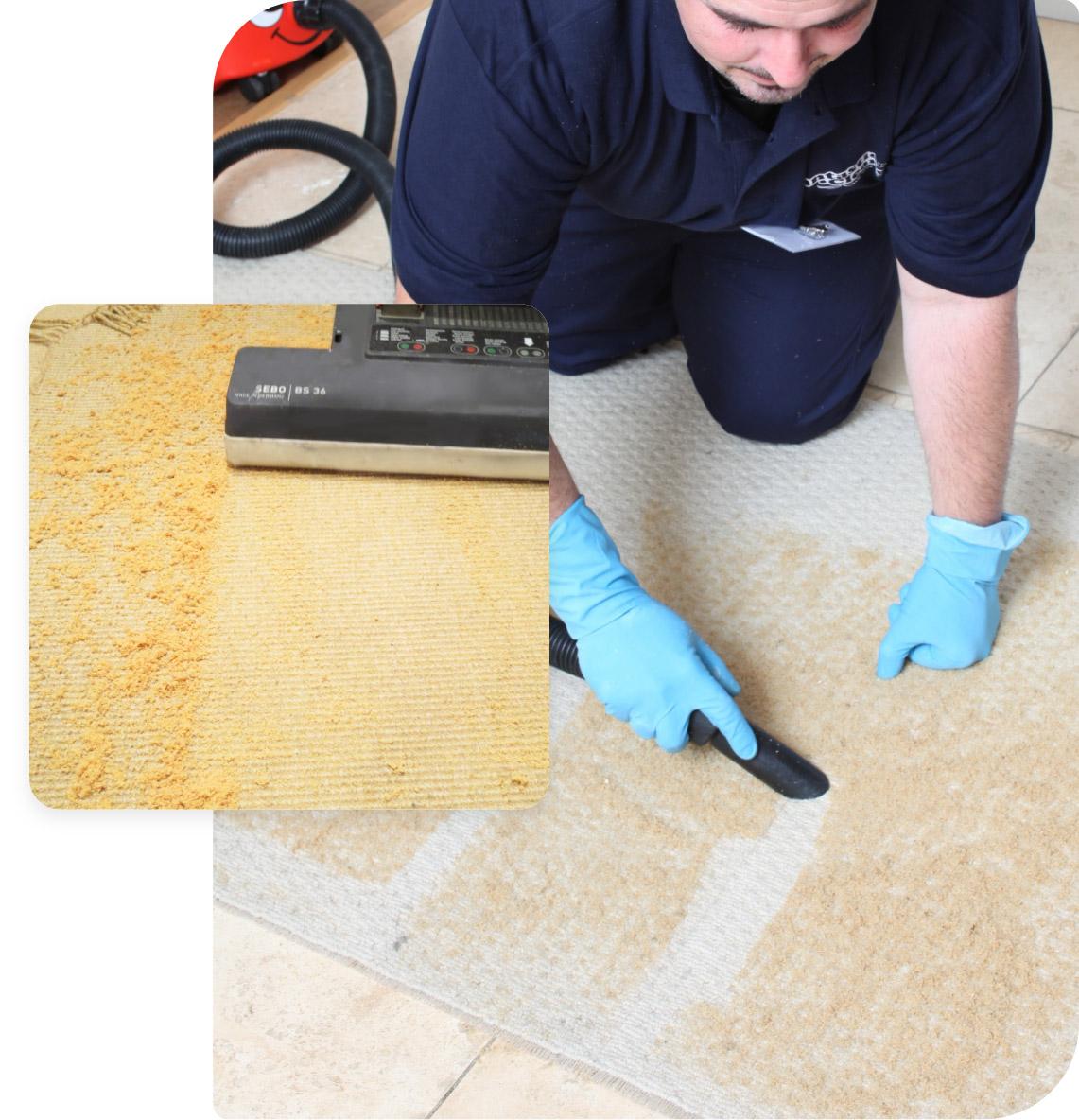
There is a useful distinction that most household advice ignores: soil sits on a fibre, a stain has bonded to it. Everything that is genuinely soil comes out with the right chemistry, enough dwell time and proper rinsing. A stain has changed the fibre itself, usually by dyeing it, and no amount of scrubbing will reverse that. Knowing which of the two is on the floor decides whether the next step is a cleaning problem or a colour-repair problem, and getting it wrong is how small marks are turned into large pale patches.
Three families of spill, three different answers
Tannins, from tea, coffee, red wine and fruit juice, respond to mild acid and to oxidising agents. Protein, from milk, egg, blood and most food, needs low heat and an enzyme, because hot water cooks it into the fibre permanently. Oil and pigment, from makeup, shoe polish and ground-in grease, need a solvent and mechanical agitation rather than water. Applying an alkaline all-purpose product to all three is the most common domestic error, and on the protein group it makes the mark permanent. A breakdown by spill type sits on carpet and rug cleaning services nationwide.
Red dye and the role of heat
Synthetic red colouring in soft drinks and children's food is an acid dye, chemically close to the dyes used on nylon carpet, which is precisely why it bonds so readily. It is not removed, it is reduced, using a reducing agent held at temperature under a damp cloth so the dye molecule breaks down and stops reflecting red. That takes patience and repeated short applications, and it risks the surrounding colour if pushed too hard. It is a slow, careful piece of work rather than a spray-and-wipe.
The mark that returns overnight
A spot dealt with in the afternoon and back the following morning has wicked. The original spill soaked past the pile into the backing and the underlay, and as the surface dried it drew that reservoir upward by capillary action, redepositing the soil at the tips of the fibres. Blotting harder makes no difference because the problem is below. The fix is to flush the area with clean water, extract repeatedly with no solution, then weight an absorbent pad over it overnight so the moisture rises into the pad rather than into the pile. Whole-room work of this kind is described on carpet cleaning team in Mitcham.
Spots that have already been treated at home
By the time a technician sees a mark it has often had three products on it. Optical brighteners leave a patch that glows under daylight, oxygen bleach leaves a pale ring larger than the original spill, and an alkaline spray left to dry becomes a sticky circle that attracts soil faster than the carpet around it. Telling someone which product was used is genuinely useful, since residue must be neutralised and flushed before anything else is attempted. A saved bottle is more helpful than a description from memory.
Fabric seating suffers worse
An upholstered arm has no backing to stop a spill and far less fibre depth to hold it, so liquid reaches the foam within seconds and the mark spreads sideways as it dries. Cushion covers that appear removable often have a different dye batch inside the seam and will not match once washed. Fabric is cleaned at low moisture, with the frame protected against water tracking down the legs, and the work falls under upholstery cleaning throughout Mitcham.
What helps before the technician arrives
Blot with a white cloth rather than a coloured one, working from the outside of a spill inwards, and resist the urge to scrub, which distorts the pile permanently. Solid material is scraped up with a spoon edge. Nothing warm goes onto anything protein-based. Spot work is charged by the time it takes rather than by the mark, so an accurate description when booking decides whether the technician allows twenty minutes or two hours. The same diary reaches the villages further south, where Coulsdon cleaning services team takes in wider household work.