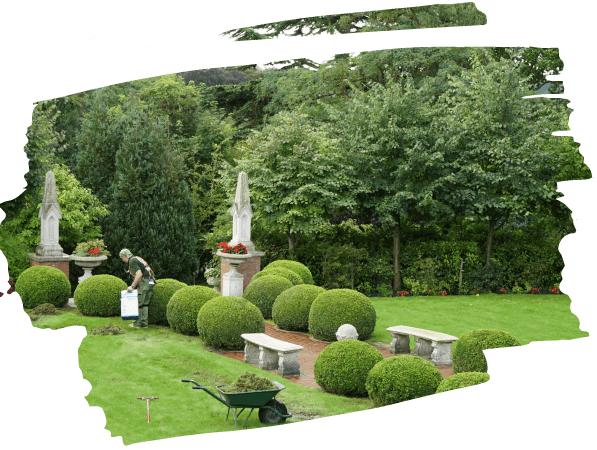
A decent lawn in Abingdon is a drainage project before it is a horticultural one. The town sits where the Ock joins the Thames, and a great deal of its housing is built on alluvial silt and river gravel with a winter water table close beneath. Grass laid on that ground without preparation goes to moss and standing water between November and March, then bakes hard in a dry August, and no amount of feeding will change either.
Why an existing lawn fails
Diagnosis comes before any decision to relay. Squelching underfoot in winter with moss through the sward points to compaction and poor infiltration. Thin grass in dry weather over the same ground usually means shallow rooting caused by that same compacted layer. A spade-cut inspection slice shows it clearly: roots turning sideways at a few centimetres, a dense grey band beneath, and topsoil measured in inches over builder's subsoil. That diagnosis decides whether the answer is renovation costing a fraction of a rebuild, or a genuine reconstruction.
Renovation where the base is sound
Where there is workable depth beneath, a lawn can usually be recovered without stripping it. Scarifying removes the thatch layer that stops water and air getting in; hollow-tine aeration lifts cores and relieves compaction properly, which solid spiking does not; a sandy top dressing brushed into the holes keeps them open; then overseeding with a mix suited to the aspect, and feeding to a seasonal programme rather than a single spring application. Done in early autumn, when soil is still warm and rain is returning, the results by the following May are substantial. Repeating that cycle annually is what fully insured weeding and tidy-ups in Abingdon provides.
Rebuilding on floodplain silt
A full reconstruction means stripping the existing surface, breaking the compacted layer, and deciding whether land drains are needed and whether there is anywhere legal for them to discharge - a soakaway on silty ground close to the water table often will not work, and a connection to a surface water system needs authority. Grading comes next, with falls away from the house and no dished areas where water can stand. Then a sand-amended rootzone rather than bagged garden soil, consolidated in layers. Turf laid in autumn knits before winter; spring turf spends its first summer under stress.
The artificial grass question, answered honestly
On a shaded, wet, heavily used plot, synthetic turf genuinely solves a problem that grass cannot. It also has to be installed as a drainage construction - a compacted stone sub-base, a permeable membrane and a laying course - or it will hold water exactly as the lawn did, only with nowhere for it to go. It gets hot in direct sun, supports no soil life, and has to be brushed and cleared of leaf litter or it grows moss in its own accumulated debris. On floodplain ground it should never be laid where it will reduce the plot's capacity to absorb water. For a family garden with reasonable light, a properly rebuilt natural lawn is usually the better long-term answer.
Trees, shade and root competition
Large trees are common on the older plots near the river, and grass under a mature canopy fails through a combination of shade, dryness and root competition that no seed mix overcomes. Crown lifting or thinning to let light through often rescues it, and that work belongs to a qualified arborist rather than a mower operator - the tree surgery team in Oxford covers it. Where light cannot be improved, replacing grass with a shade-tolerant ground cover or a bound gravel surface ends a losing battle. Heavier ironstone and clay ground to the north behaves differently again, which is the basis of the work under fully insured garden makeovers in Banbury.
Timing, and what to expect around the work
Early autumn is the best window for renovation, seeding and turfing; late spring and midsummer are the worst. Groundworks need a reasonably dry spell because silt turns to slurry under a machine. Pricing follows the area, the depth of reconstruction and the drainage involved, quoted by element so renovation can be tried before rebuilding is committed to. Soil and grit tracked indoors during a rebuild come out under the Abingdon branch, with a wider household clean available through same-day cleaning services in Abingdon, and the full design and build range is described under fully insured garden makeovers.