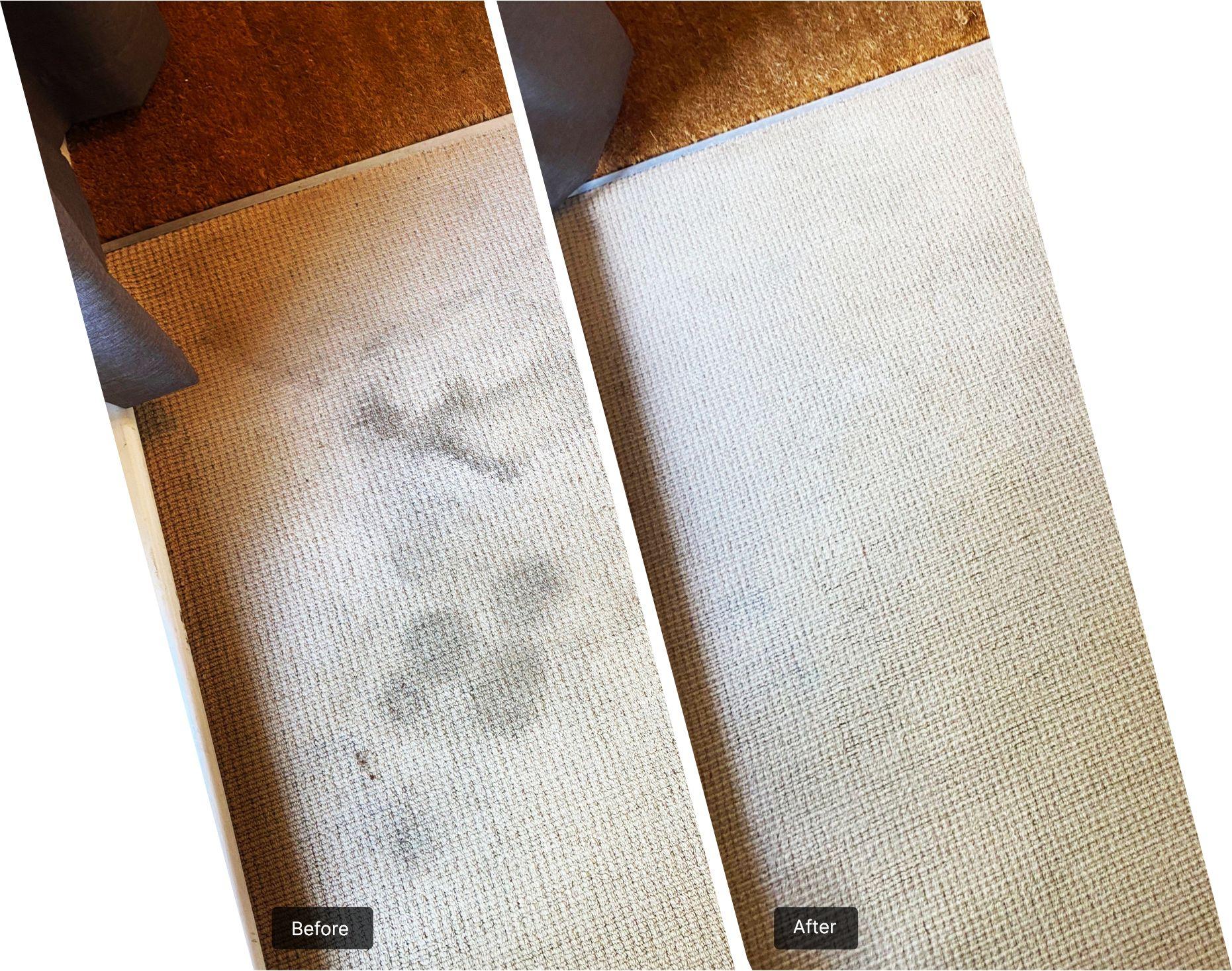
Drying is the stage that decides whether a carpet clean in Southampton has worked. SO14 covers the city centre, where much of the housing is flats — some in post-war towers, some in converted upper floors above commercial ground floors — and the combination of coastal humidity, sealed modern glazing and limited cross-ventilation means a floor that would be dry in four hours further inland can still feel cool and damp the next morning.
Why a slow dry-down leaves marks
As moisture evaporates it travels upward through the pile, and it does not travel alone. Dissolved soil sitting in the lower pile and in the backing is carried to the fibre tips and left there as the water leaves, which is why a patch that looked perfect at the end of a job can reappear as a faint shadow overnight. On carpets with a jute secondary backing the same mechanism brings up cellulosic browning, a yellow-tan cast that is far easier to prevent than to correct.
Air movement does more than heat
The instinct on a humid day is to open every window, which on the south coast can push warm moist air into a room and slow evaporation rather than speed it. A closed room with a dehumidifier and low-profile air movers angled to sweep across the surface will dry a floor faster. Extraction technique matters just as much: dry strokes with the trigger off after each wet pass remove a large share of the moisture before any drying equipment is needed.
Flats above other flats
Working on an upper floor carries a risk that does not exist in a house. Over-wetting a carpet laid on a concrete deck with a thin underlay can put water past the skirting line, and in a converted timber floor it can reach the ceiling below. Solution volume is controlled deliberately, tanks are filled and emptied in the kitchen or bathroom rather than carried through living space, and hoses are run with mats under connections.
Sofas and mattresses in the same room
A cleaned carpet often makes the seating look worse by comparison, and in a compact city flat the two are inches apart. Fabric upholstery holds body oils and airborne cooking soil in the same way carpet lanes do, but it is cleaned with far lower moisture and much tighter control, since foam cushions hold water for days. The distinctions are set out on sofa cleaning.
Salt in the air and what it leaves behind
Air this close to the water carries a fine salt aerosol along with wind-blown grit, and both settle on textiles near an open window or a balcony door. Salt is hygroscopic: once it is in the pile it draws moisture from the room and keeps the fibre feeling faintly cool and clammy long after any cleaning has finished. It also resists a straightforward detergent pass, because the problem is a soluble mineral rather than a greasy soil, so what shifts it is generous clear-water rinsing and full recovery rather than stronger chemistry.
Student turnover and the September window
A large share of central housing changes hands over a few weeks at the end of summer, which puts every carpet in the city on the same schedule. Booking into that window early is worth more than any negotiation on the day, and an empty property always cleans better than one still half packed.
What a booking involves
Rooms are counted rather than clocked, with stairs and landings priced as separate areas. Parking near the waterfront and in the central blocks is generally permit-controlled, so a bay or a visitor permit arranged in advance saves time at the start of a visit. The underlying method, fibre by fibre, is explained on carpet and rug cleaning services UK, and households comparing conditions with the chalk valley to the north will find a different set of problems entirely on carpet cleaning services in Winchester.