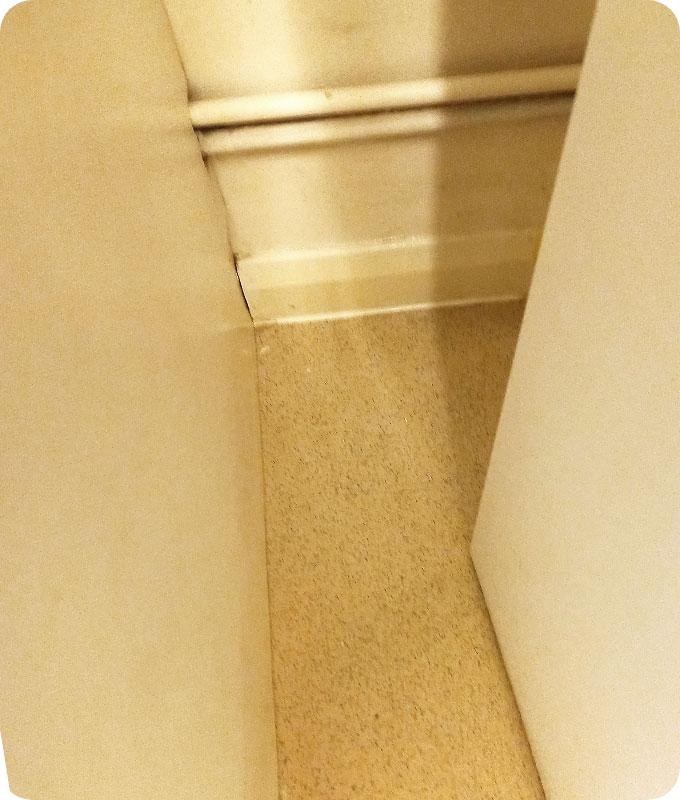
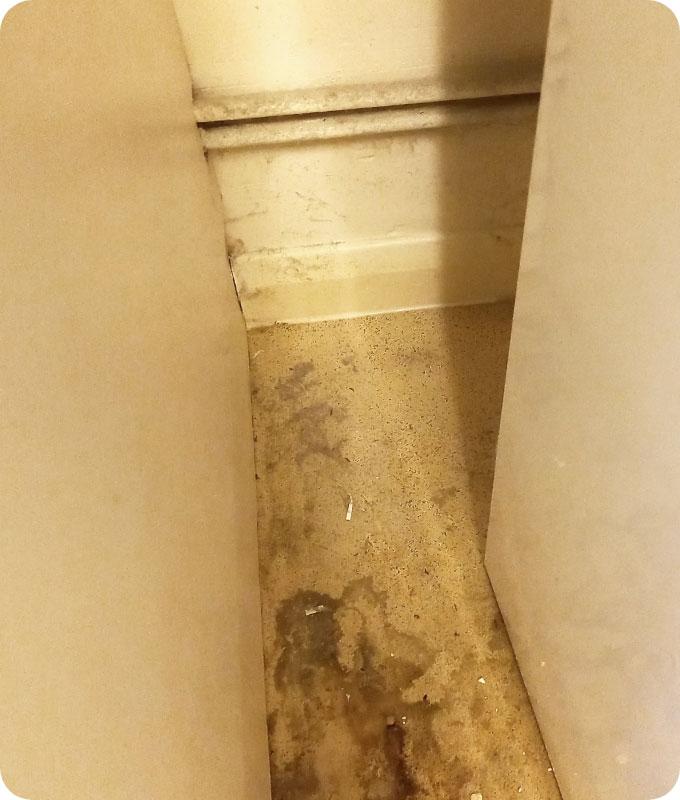
Grease does not stay above the hob. Frying releases an aerosol fine enough to travel with the room's air currents, and in the compact kitchens common to W1J mansion flats — often open to the living space, frequently with no window that opens at all — it lands on cupboard doors, the top of the fridge, the wall above the dado, the coving and eventually the ceiling. Left alone it oxidises and hardens into a yellow-brown film that ordinary washing-up liquid simply slides over.
The chemistry that shifts hardened fat
Fresh grease comes off with warm water and a general-purpose product. Old grease that has polymerised needs something alkaline, and it needs contact time rather than effort. Applied and left for a few minutes, the product breaks the film so it can be wiped away with light pressure; attacked immediately with a scourer, the same film gets pushed into the surface texture and burnishes the door instead. Alkaline products are then rinsed off, because residue left on a painted or vinyl-wrapped door goes tacky and collects dust faster than the grease did.
Extraction, filters and recirculating hoods
Many flats in these blocks cannot vent to outside, so the cooker hood recirculates through a charcoal cartridge with a metal mesh grease filter in front of it. The mesh is washable and belongs in hot water with a strong detergent, flat, long enough for the fat to release; the charcoal is not washable and is a replacement item on a schedule. Blocks of the same period a little north of here use the identical arrangement, and domestic cleaning for landlords in Marylebone deals with those kitchens on the same principle. A saturated filter stops pulling, the aerosol spreads further into the room, and every other surface gets dirtier. Cleaning the kitchen without dealing with the hood is treating the symptom.
Hobs, and the damage caused by the wrong pad
Induction and ceramic glass mark permanently under an abrasive pad; burnt sugar comes off with a purpose-made scraper held almost flat, then a cream polish. Cast-iron pan supports from a gas hob are soaked rather than scrubbed, and dried thoroughly, since they rust within a day if left wet. Stainless steel splashbacks are worked along the grain, not across it, and finished dry to avoid the water spotting that hard London supply leaves behind on everything. Surface-by-surface differences of this sort run through a whole property, which is why nationwide cleaning services is organised by task rather than by room.
Waste, and the smell that survives a clean
Food caddies and bin bases are the most common reason a kitchen still smells after every surface has been done. Bins are emptied, washed inside and out, dried and left open for a few minutes; caddy lids and their seals hold residue in the rim. In blocks where waste goes to a communal store down in the basement, the route matters as much as the task, because a leaking bag on a carpeted corridor creates a second job for somebody else.
Clearing space before a deep clean
A thorough kitchen visit needs the worktops empty and, ideally, the floor units accessible. Where an old appliance is being taken out or a room has to be stripped back before the work starts, the lifting and removal side is a separate trade and local specialists covers it. The cleaning follows once the space is clear rather than working around obstacles, which is quicker and produces a result that lasts.
How a deep kitchen visit is quoted and run
Work of this kind is priced by time, with the estimate driven by how long the build-up has been accumulating and how many units there are, not by square footage. Ovens are usually treated as an item in their own right, since racks and shelves are best removed and soaked while the cavity is worked on. Keeping the result once it has been reached is then a question of frequency rather than effort, which is what a local pro near you is designed around.